

Powerstroke Performance Parts for Heavy Loads
Table of Contents
- Why Heavy Loads Change What Your Powerstroke Needs
- Best 6.7 Powerstroke Towing Mods for Real Payload
- EGT Monitoring for Diesel Towing: The Gauge That Saves Engines
- Powerstroke Performance Tuning for Heavy Loads: What Actually Works
- Powerstroke Performance Parts by Engine Generation
- Maintenance Intervals for Modified Trucks
- Legal and Emissions Compliance for Tuned Trucks
- Frequently Asked Questions
Last Updated: September 26, 2026
Why Heavy Loads Change What Your Powerstroke Needs
A loaded trailer changes everything about how your truck makes power. When you hook up 15,000 pounds and point the truck uphill, the engine that felt strong empty suddenly runs hot, pulls timing, and struggles to hold speed. That shift is why powerstroke performance parts for heavy loads are not the same parts you would buy for a truck that mostly runs empty.
Owners often chase peak horsepower, then discover the real bottleneck is heat, not power. A diesel making 500 horsepower on a dyno can still overheat its exhaust gas temperatures (EGT) at 60 mph on a 6% grade with a trailer behind it.
The parts that matter most under load are the ones that manage heat and keep the powertrain alive. Below, we break down which upgrades actually help, what to monitor, and how to stay legal.
Best 6.7 Powerstroke Towing Mods for Real Payload
The best 6.7 Powerstroke towing mods prioritize sustained power and cooling over peak numbers. A truck that holds 65 mph up a long grade with stable temperatures beats one that makes a big dyno pull and then derates halfway up the hill.
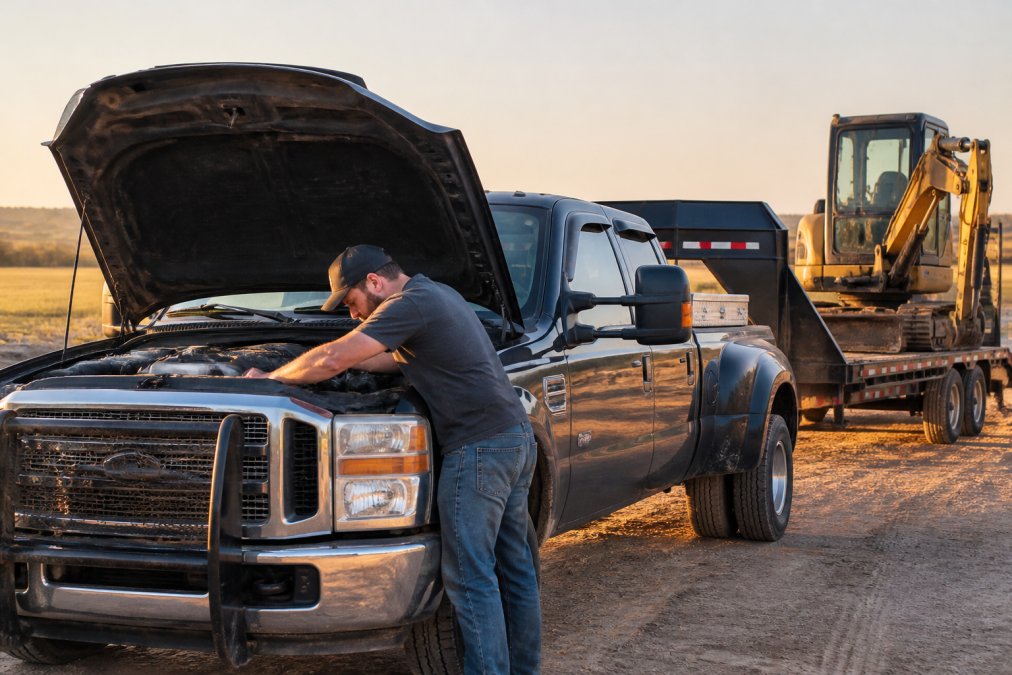
The upgrades that consistently help under load:
- Intercooler and charge pipe upgrades to lower intake air temps and reduce heat soak
- Larger transmission cooler to keep fluid temperatures in check during long pulls
- High-flow exhaust and downpipe to move exhaust gases out and cut backpressure
- Cold air intake for cleaner, cooler airflow to the turbo
- Lift pump and fuel system upgrades to hold fuel pressure under sustained demand
- Cylinder head studs to handle higher cylinder pressures without gasket failure
What most guides miss is that these parts work as a system. Adding a tuner without addressing cooling usually just moves the failure point from the engine to the transmission.
EGT Monitoring for Diesel Towing: The Gauge That Saves Engines
EGT monitoring for diesel towing is the single most important safety measure on a modified truck, and it is also the metric most performance articles ignore. Exhaust gas temperature tells you how hard the engine is working, and sustained high readings are what melt pistons, crack turbochargers, and warp exhaust valves. Horsepower numbers on a dyno do not tell you whether the truck will survive a long grade with a trailer, EGT does.
A pyrometer (EGT gauge) installed pre-turbo gives you a real-time reading. Under heavy load, sustained pre-turbo EGT should generally be kept below roughly 1,250°F, though the exact safe ceiling depends on your setup, your tune, and how long the pull lasts. A brief spike is far less damaging than a sustained climb at the same number. The gauge matters more than the number: it tells you when to back out of the throttle before damage happens.
What good looks like on a heavy pull. The towing-specific performance metric that separates a well-built truck from a dyno queen is EGT stability, not peak EGT. A truck with proper airflow, fueling, and cooling will climb a long grade with EGT holding steady in a safe band. A truck with a hot tune and stock cooling will see EGT climb continuously until the engine derates or something fails. When you compare parts, ask what each one does to EGT under sustained load, not what it does to peak horsepower.
Transmission fluid temperature is the second metric nobody watches. On a heavy pull, the transmission often runs hotter than the engine, and heat is what kills automatic transmission fluid and, eventually, the transmission itself. A transmission fluid temperature gauge is cheap insurance. Sustained transmission fluid temperatures above roughly 220°F can be a warning sign, and above roughly 250°F may indicate a need to stop and cool. A larger transmission cooler, a deeper pan, and a tune that adjusts shift points to reduce slippage are upgrades that can help manage this.
Boost pressure is the third reading worth having. Boost and EGT together tell a story. If boost climbs while EGT spikes, you have an airflow or fueling problem worth fixing before the next load. If boost falls while EGT climbs, you may have a boost leak or a turbo issue. Watching all three, EGT, transmission fluid temp, and boost, turns guesswork into diagnosis.
This is the gap most performance parts content skips: the parts that reduce EGT and manage transmission heat under sustained load are worth more to a heavy-load tow rig than the parts that add peak horsepower. Build around the gauges, not the dyno sheet.
Powerstroke Performance Tuning for Heavy Loads: What Actually Works
Powerstroke performance tuning for heavy loads works best when it targets torque delivery and thermal management, not just peak horsepower.
- Add torque lower in the RPM range for better pulling
- Limit fuel delivery to control EGT
- Adjust transmission shift points to reduce heat and slippage
- Keep boost pressure within safe limits for the turbo
The transmission is the weak link most owners ignore. A tune that adds torque without a matching transmission strategy leads to slipping, hot fluid, and eventually a rebuild.
Powerstroke Performance Parts by Engine Generation
Parts do not transfer cleanly across generations. The 7.3L, 6.0L, 6.4L, and 6.7L Powerstroke engines each have different fuel systems, turbo setups, oiling, and known weak points, so the right upgrade depends on which engine is under the hood and how much weight it pulls.
| Engine | Known Weak Point Under Load | Priority Upgrades | What to Watch |
|---|---|---|---|
| 7.3L | Low stock power, aging fuel and oil delivery | Injectors, lift pump, intake, HPOP service | Fuel pressure drop under sustained demand |
| 6.0L | Head gaskets, EGR cooler, oil cooler | Head studs, EGR cooler, coolant filtration | Coolant delta and oil temp creep on grades |
| 6.4L | Twin-turbo heat soak, fuel system | Downpipe and exhaust, intercooler, fuel system | Compound turbo heat and EGT spikes |
| 6.7L | Turbo and emissions complexity, trans heat | Intercooler, transmission cooler, towing tune | DPF regen frequency and trans fluid temp |
Maintenance Intervals for Modified Trucks
Modified trucks need shorter maintenance intervals than stock ones. The extra heat and load accelerate wear on fluids and filters, so the factory schedule is too long once you start towing heavy.
- Engine oil: change sooner than the factory interval, especially with frequent towing
- Fuel filters: inspect and replace on a shortened schedule to protect injectors
- Transmission fluid: check temperature and condition often; heat breaks fluid down faster
- Coolant: keep the system clean and top off with the correct spec
- Air filter: check more often in dusty job-site conditions
Legal and Emissions Compliance for Tuned Trucks
Emissions compliance is the part of diesel tuning most owners would rather not think about, and it is also the part that carries real consequences. Federal law under the Clean Air Act prohibits tampering with emissions control equipment on vehicles, and that includes removing or disabling the diesel particulate filter (DPF) or the exhaust gas recirculation (EGR) system on a truck used on public roads.
Frequently Asked Questions
What are the best performance upgrades for a 6.7 Powerstroke?
For heavy loads, start with a cold air intake and a free-flowing exhaust to lower EGTs, then add a transmission cooler and upgraded torque converter to handle the extra power. A custom tune from a reputable provider like Silverline Diesel can optimize boost pressure and fuel delivery for towing without pushing the engine past safe limits. Cylinder head studs and a lift pump are smart additions if you plan to run higher boost or tow near max capacity regularly.
How does EGT monitoring for diesel towing help prevent engine damage?
Exhaust gas temperature (EGT) is the single best indicator of how hard your turbo and pistons are working. When EGTs climb past roughly 1,200-1,300°F for extended periods, you risk melting pistons or cracking the turbo. A pyrometer gauge or a tuner with live EGT display lets you back off the throttle or downshift before damage occurs. For heavy loads, keep sustained EGTs under 1,250°F and let the turbo cool before shutdown.
Are aftermarket air intakes and exhaust systems worth it for Powerstroke towing performance?
Yes, when matched to your engine and load. A cold air intake reduces restriction and lets the turbo spool faster, improving throttle response and lowering EGTs under load. An upgraded exhaust manifold and downpipe reduce backpressure, which helps the turbo breathe and keeps heat moving out of the engine. The gains are modest on their own, but combined with tuning they make a noticeable difference in towing performance and drivability.
What maintenance intervals should I follow after modifying my Powerstroke for heavy loads?
Modified trucks need shorter intervals than stock. Change engine oil and fuel filters every 5,000-7,500 miles instead of the factory 10,000, and inspect the transmission fluid every 15,000 miles if you tow often. Check coolant filtration and EGR components at every oil change. Boost leaks, exhaust manifold cracks, and turbo shaft play should be inspected every 20,000 miles. Keeping up with these intervals is what separates a reliable tow rig from a breakdown waiting to happen.